


Events

- This event has passed.
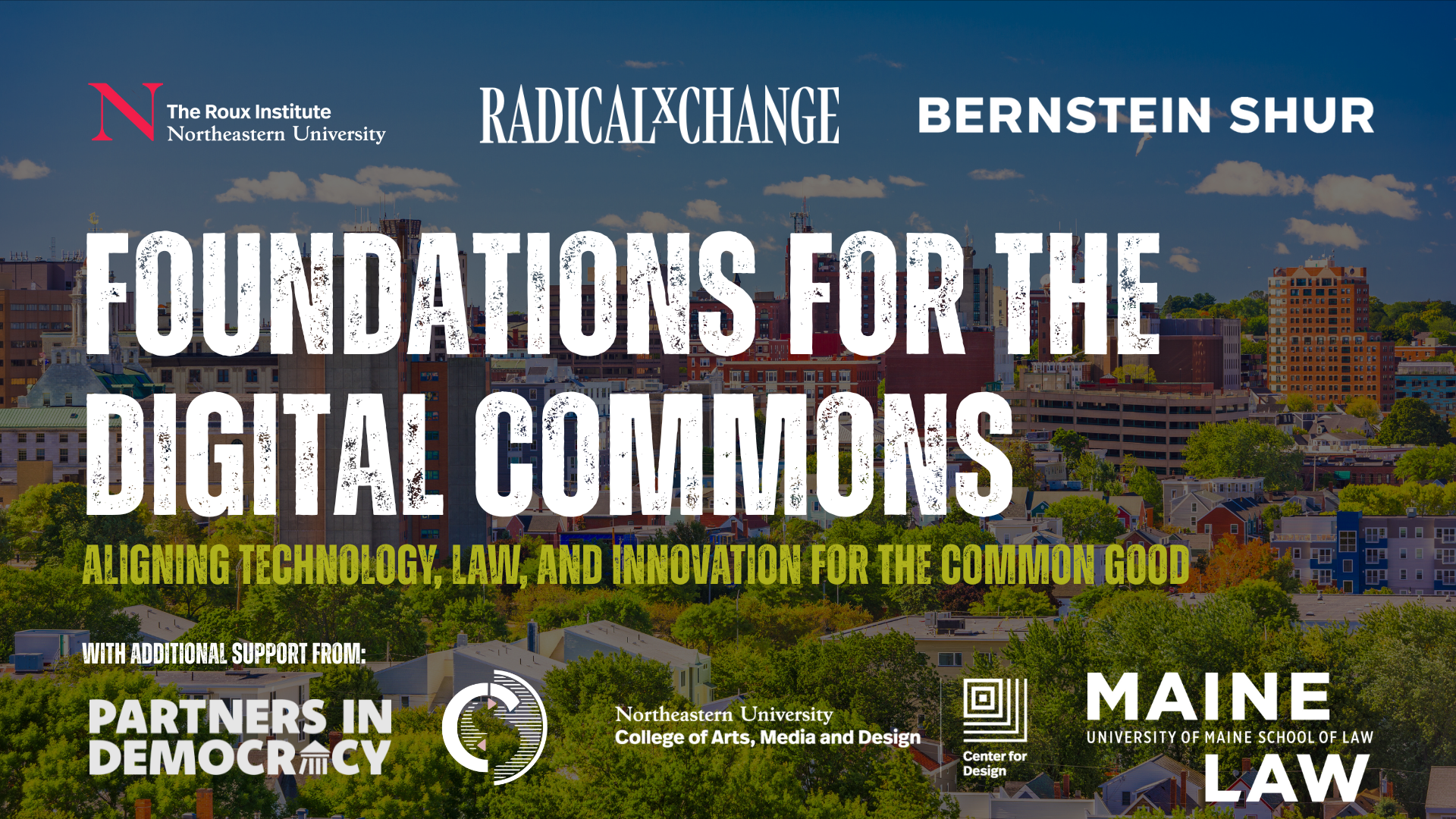
Foundations for the Digital Commons: Aligning Technology, Law, and Innovation for the Common Good
October 30, 2025 @ 8:30 am - October 31, 2025 @ 3:00 pm
Presented by RadicalxChange, Bernstein Shur, and Northeastern University’s Roux Institute
This two-day event unites leaders, builders, lawyers, and technologists to advance the future of tech, policy and digital infrastructure to benefit the common good. Together, we’ll tackle emerging challenges and bold opportunities in collective data governance, digital deliberation, democratic innovation, and the rapidly evolving landscape of AI, antitrust, and intellectual property.
Hosted by the Roux Institute in partnership with RadicalxChange, and Bernstein Shur, the event will feature:
- Fast-paced lightning talks, breakout sessions, and collaborative deliberations
- Workshops to align on legal frameworks and policy solutions
- A civic tech hackathon focused on digital deliberation tools and interoperability
- Curated networking mixers and engaging programming—all set in beautiful Portland, Maine
Featured Workshops:
- Information Innovations; Public <> Legislators
- Citizens’ Assemblies 101: Designing Democratic Infrastructure for the AI Age
- Digital Deliberation at Scale: Demonstrations
- Data Intermediaries for the Public Good: Protecting Privacy, Empowering Publishers
- Cooperatives in the Data Economy: Decentralizing Data, Democratizing Value
- Accelerating Digital Civic Infrastructure in US
Speakers include:
- Jeb Bell, Project Liberty Institute
- Liz Barry, Metagov
- Beth Noveck, The Burnes Center for Social Change
- Elicia Wilson, Gitlab Foundation
- Nathan Sanders, Berkman Klein Center for Internet & Society
- Jake Hirsch-Allen, The Dais at Toronto Metropolitan University
- Stuart Lynn, CrownShy
- Lacey Strahm, OpenMined
- Courtney Radsch, Open Markets Institute
- Jerren Chang, Partners in Democracy
- Matt Prewitt, RadicalxChange
- Dave Lesher, CalMatters
- Beth Goldberg, Google Jigsaw
- Christine Kim, Mozilla Foundation
- Axel Dauchez, MAKE.org
Agenda
Thursday, October 30 – Framing & Foundations
8:30–9:00am | Check-in & Coffee
9:00–9:15am | Welcome from Roux Institute, Bernstein Shur, & RadicalxChange
9:15-10:15am | Information Innovations: Public <> Legislators
For democracy to thrive, citizens must know what government is doing — and government must know what citizens want. CalMatters shines light on legislative actions for the public, while Crown Shy channels public consensus back to policymakers. Grounded in expertise from congressional tech modernization efforts, this panel explores how completing both sides of the circuit builds trust and accountability.
Panelists: Stuart Lynn (Crownshy); Dave Lesher (CalMatters) ; Lorelei Kelly (Public Good Group)
Intro/Moderator: Matt Victor (Bernstein Shur)
10:15- 10:20am | Break
10:20-11:20am | Citizens’ Assemblies 101: Designing Democratic Infrastructure for the AI Age
As emerging technologies reshape the economy and society, the question of “who decides” becomes more urgent. Citizens’ assemblies offer a proven model for engaging everyday people in complex public decisions, from climate policy to AI governance. Learn how and why citizens’ assemblies work, and to collaboratively explore how one might be used to address workforce development in the digital age.
Panelists: Zabrae Valentine (Public Good Group); Jennifer Chace (USM); Elicia Wilson (Gitlab Foundation);
Intro/Moderator: Jake Hirsch-Allen (the Dais);
11:20 – 11:30am | Break
11:30am- 12:30pm | Scaling Deliberation to Millions; Demo & Discussion
Digital tools are reshaping how citizens deliberate and how policymakers listen. Google Jigsaw brings insights from its work on online discourse and safeguarding democratic debate, while MAKE.org shares its experience engaging millions of Europeans in structured, large-scale participation. This panel explores what it takes to scale deliberation responsibly, and how different contexts are turning digital debate into actionable guidance for governments.
Presenters: Axel Dauchez (MAKE); Beth Goldberg (Jigsaw)
Intro/Moderator: Liz Barry (Metagov)
12:30 – 1:15pm | Lunch
1:15- 2:10pm | Data Intermediaries for the Public Good: Protecting Privacy, Empowering Publishers
AI has upended the relationship between publishers and platforms, raising questions of control, attribution, and fair compensation. This panel will explore how trusted data intermediaries—supported by privacy-enhancing technologies—can give publishers tools to manage their content, safeguard privacy, and negotiate collectively with AI developers. By shifting from extractive to collaborative models, TDIs offer a path toward a more sustainable and equitable digital information economy.
Panelists: Courtney Radsch (Open Markets Institute), Lacey Strahm (OpenMined); Matt Prewitt (RadicalxChange)
Moderator: Nathan Sanders (Berkman Klein)
2:10- 2:20pm | Break
2:20- 3:20pm | Cooperatives in the Data Economy: Decentralizing Data, Democratizing Value
As data becomes one of the world’s most valuable resources, cooperatives offer a promising model for shared ownership and governance. Their decentralized, community-based structure makes them uniquely suited to steward data responsibly and to ensure that digital identity, personal information, and AI-era value creation benefit the many, not the few. Join us to explore the legal, technical, and organizational innovations that position cooperatives as essential infrastructure for the digital age.
Panelists: Jeb Bell (Project Liberty); Elettra Bietti (Northeastern Law); Christine Kim (Mozilla Foundation)
Moderator: Theo Skeadas (All Tech is Human)
3:20- 3:30pm | Break
3:30-4:00pm | Keynote: Accelerating Digital Civic Infrastructure in US
Beth Noveck (The Burnes Center for Social Change, Northeastern University)
4:00- 5:00pm | Break & Walk
5:00-7:00pm | Evening Reception (Hosted at The Center for Law + Innovation at Maine Law)
Friday, October 31 – Innovation Sprint
How might we design digital tools, platforms, or governance models that responsibly leverage Maine’s data and resources—including housing, workforce development, and energy infrastructure — into a shared public commons, while keeping in mind issues of digital equity and privacy, so that Maine not only addresses its local challenges but also becomes a model for scalable, equitable solutions that other states and countries can adopt?
8:30-9:00am | Breakfast & Networking
9:00-10:30am | Inspiration & Problem Framing
10:30 – 10:45am | Team Formation & Planning
10:45 – 11:45am | Research & Discovery Sprint
11:45 – 12:15pm | Working Lunch
12:15-1:15pm | Pitches & Group Feedback
1:15- 1:30pm | Closing Circle
Travel & Accommodations
Hotels
We’ve secured discounted rates at the following hotels within walking distance to the venue:
Flying into Portland
- The nearest airport is Portland International Jetport (PWM), located just 15 minutes from downtown.
- From the airport, you can take a bus, taxi, or use Uber/Lyft to get to the Roux Institute.
Flying into Boston
- Concord Coach Lines offers direct bus service from Logan Airport to downtown Portland.
- Buses run multiple times daily, with pickup right at each terminal.
- The trip takes about 2 hours and drops you off at Thompson’s Point in Portland.
- From there, it’s a 10–15 minute ride to the Roux Institute by taxi, Uber/Lyft, or local bus.
Alternatively, you can rent a car and drive (approx. 2 hours north via I‑95).
If you’re flying into Boston Logan International Airport (BOS), you have a few easy options to get to Portland:
Tip: Book Concord Coach in advance at concordcoachlines.com for best availability.
Subscribe to Our Newsletter
Keep up with the latest! Subscribe to our newsletter to learn about upcoming events, meet our students, discover partnership opportunities, and more!