

Building the Digital Commons
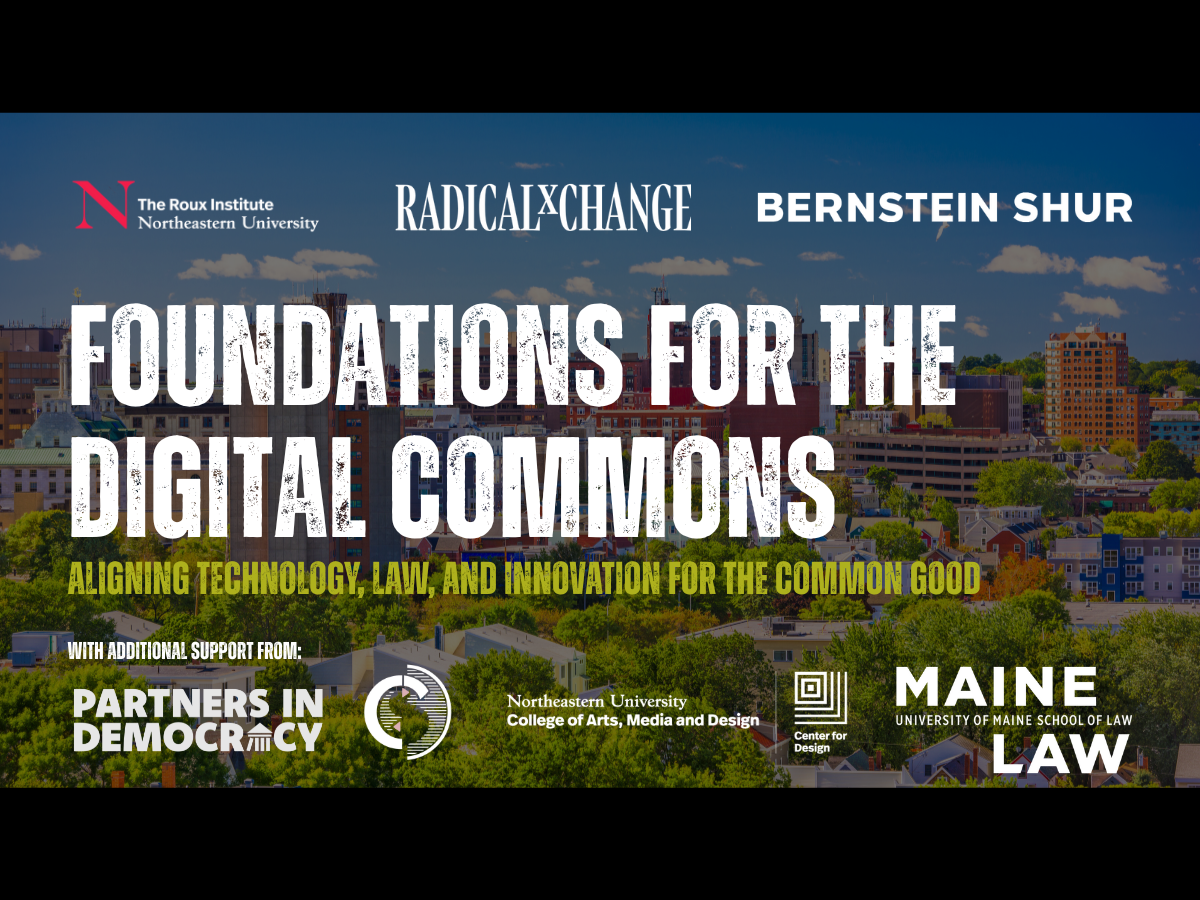
Democracy and technology are on a collision course. What are we going to do about it? If you want to be part of the solution, Foundations for the Digital Commons: Aligning Technology, Law, and Innovation for the Common Good, running from Thursday, October 30 through Friday, October 31, is for you. Hosted by Northeastern University’s Roux Institute in partnership with RadicalxChange and Bernstein Shur, the event will feature:
- Thought-provoking panels exploring the intersection of law, innovation, and civic technology
- Hands-on workshops to align on actionable legal frameworks and policy solutions
- A high-energy innovation sprint where participants will design data-driven tools and governance models that serve the public good
- Curated networking experiences connecting attorneys, technologists, policymakers, and entrepreneurs driving systems-level change
We connected with three of the event organizers to learn more about the digital commons and who will benefit from attending this event. Keep reading to learn more from Anna Ackerman, entrepreneurship programming manager at the Roux Institute, Matt Prewitt, president of RadicalxChange, and Matt Victor, associate at Bernstein Shur, and RSVP now to be part of the conversation.
Tell us about the digital commons – how would you explain the concept to someone who’s never heard of it?
Matt Victor: Think of the digital commons as two parts. One is the set of public tools we all use – like Wikipedia or even the basic systems that let us send email. The other is the data, both individual and collective, which powers so much of today’s digital world. The internet makes it easy to connect and share, but we have only scratched the surface of its full potential to provide broad benefits. Consider the experience of searching on Wikipedia versus spending time on social media. Other examples, like government open-data portals and Mozilla’s Common Voice show how communities can pool and govern data to confer benefits broadly.
Why is now such an important time to tackle these challenges?
Matt Prewitt: Fifteen years ago, if you said that democracy and technology were on a collision course, nobody believed you. Five years ago, it was still a complicated conversation. Today it’s so obvious that the question has become: what are we going to do about it? How are we going to update our ways of thinking about democracy so that they’ll remain relevant? This is a hard moment, but also refreshing. It feels possible to have a conversation that starts at 60 miles per hour and gets into the “how” of reinventing democracy.
Think of the digital commons as two parts. One is the set of public tools we all use – like Wikipedia or even the basic systems that let us send email. The other is the data, both individual and collective, which powers so much of today’s digital world. The internet makes it easy to connect and share, but we have only scratched the surface of its full potential to provide broad benefits.
Matt Victor
Associate, Bernstein Shur
How could society benefit if we align on how to advance the digital commons?
Matt Victor: Fortunately, we don’t have to guess at this. We’ve already seen success achieved at scale in places around the world (notably, Taiwan). In the US, society already benefits from the digital commons – whether through Wikipedia’s knowledge repository, open-source software underlying the digital economy, or public library networks going digital. As we expand that commons with platforms and business models built for trust, collaboration, and connection, the impact will multiply. A new wave of digital tools is giving people real power over how their data is governed and ensuring they share in the value it creates. And with algorithms designed around commonly held values, we have the chance to heal civic fractures and rebuild a shared online reality.
Who should attend the event? What will the take away?
Matt Prewitt: Civic tech builders, policymakers, influencers, and lawyers who recognize that the problem is deeper than partisanship and culture wars. We have a lot of work to do to persuade most people that democracy can solve the problems of the 21st century. The journey starts where our feet are.
There’s a hackathon on the schedule – tell us more about that.
Anna Ackerman: The hackathon will bring together innovators, community members, and technologists to explore how Maine can responsibly transform its data and resources—spanning housing, workforce, and energy—into a shared public commons. With an underlying focus on digital equity and privacy, participants will design tools, platforms, and governance models that tackle local challenges while imagining scalable solutions that can inspire communities across the country.
How much does it cost to attend?
Anna Ackerman: The event is free to attend, thanks to the generous sponsorship and partnership from presenting sponsors RadicalxChange and Bernstein Shur, and additional support from Partners in Democracy, Core Strategy Consultancy, University of Maine School of Law, and Northeastern University’s College of Arts, Media, and Design.